JUSSI
OJALA
About
Since 1984 Marie and I have been working here, outside the small town Skara in the western part of Sweden.
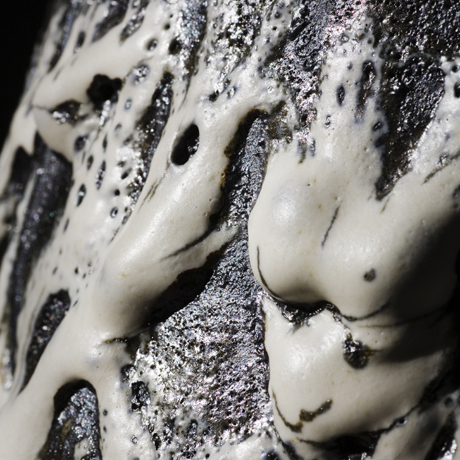
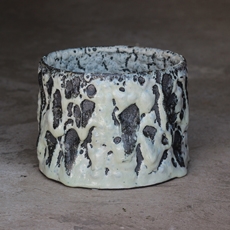
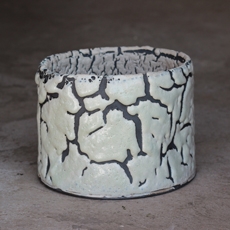
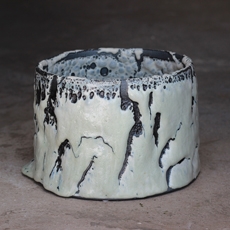
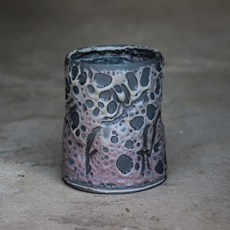
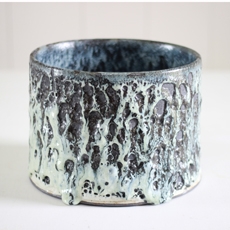
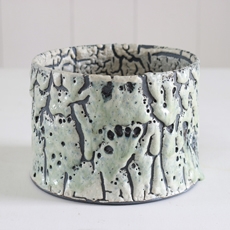
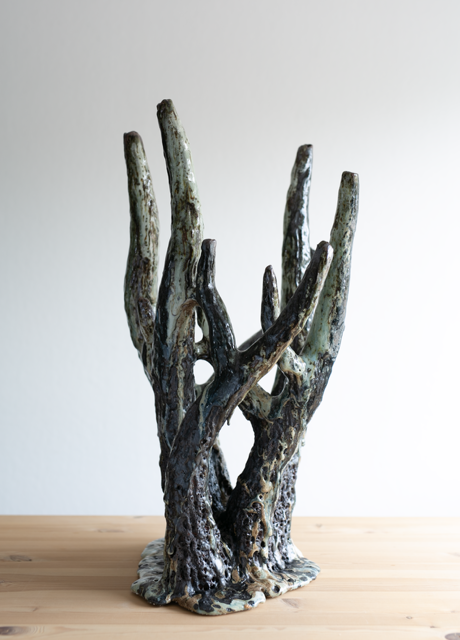
I usually work with thrown pieces in stoneware clay, jars or cylinders, covering them with a dark layer of slip. The glazes are an essential part of the expression, crawling, bubbling thick layers invites a bit of hazard in to my work. I fire in an old gas kiln.
“The glaze covering Jussi Ojala’s ceramic works seems to burst, breaking up in mysterious patterns and gliding down along the sides of the vessel until coming to a halt in thick bulges resting around its base. Often, the glaze appears to make up but a recalcitrant partner to the underlying form, unruly and defiant sometimes to the point of threatening to part ways with its companion. At the same time, however, the two remain prerequisites to each other. They are united, though not in some shared singularity but rather cohabiting in a duality that draws attention to the distinct character of its separate components. If during modernism’s period the Swedish ceramic artists enjoyed draping their glaze like a tight-fitting glove on a harmonious vessel body, the glazes on Jussi Ojala’s pieces sit like a restless, swelling mass on forms that themselves seem warped and trembling.
We are confronted by a movement that has frozen in its course, yet without repose in tranquillity. Our gaze is not allowed to settle and rest. The glazes break open, but not, to be sure, for the sake of revelation. On the contrary, they do their utmost to obscure the real shape of the vessel. The forms remain concealed beneath the irregular, haphazard patterns and relief effects, and the contours of the vessel’s body become altered by the thickness of the glaze. What results is seldom beauty in its immediate sense; rather, these pieces fascinate us with their capricious and coarse nature. However, in Jussi Ojala’s works from the past few years, we also find many instances of unexpected beauty suddenly emerging from the midst of all that we encountered as eruptive and deformed. Here it can be a pot in which the convulsions of the glaze are arrested in a sort of guarded concentration, as if only to gather strength before the final fit. The beauty is in the brinkmanship of this balancing act. In another piece, fragments of the shattered surface of a white glaze assemble in a cluster like sparkling snowflakes falling over a night sky; we stand before this vessel like a child staring at the stars.
Jussi Ojala’s ceramic works frequently display a close connection to nature and, maybe above all, an affinity to the fundamental human condition. Personal experiences and impressions are compressed into pieces that on the whole can only be described as monumental. The monumentality of the pieces lies not always in their dimensions but in their complexity – they constitute something that is a product of both a clearly formulated vision and a volatile process.”- Love Jönsson 2006
Works
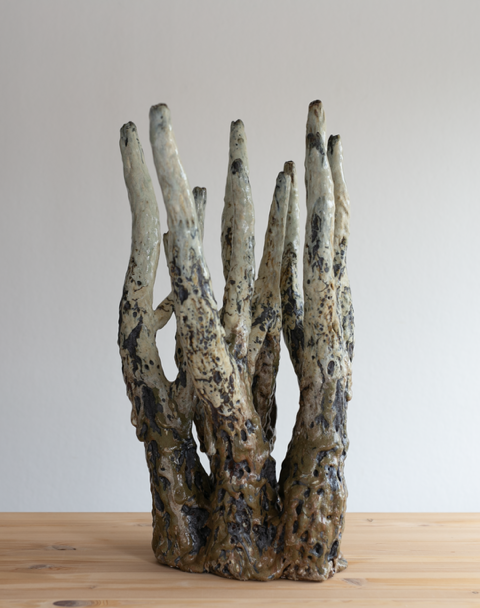
This section presents a carefully curated overview of my artistic practice. Rooted in over forty years of dedicated exploration, my oeuvre reflects a profound investigation into the language of clay and the living qualities of natural ash glazes. From functional stoneware vessels to expressive sculptural forms, each work embodies the dialogue between human intention and the transformative forces of fire and ash.These pieces stand as silent witnesses to my ongoing conversation with materiality, nature, and existence.
CV
Selected soloexhibitions
Galerie de l´Ancienne Poste, Toucy France 2019
Berg gallery, Stockholm Sweden 2017
Puls Contemporary Ceramics, Brussels, Begium 2017
Konsthantverkarna, Stockholm Sweden 2016
Konsthantverkarna, Karlstad, Sweden 2015
blås&knåda Gallery Stockholm 2013
Lidköping Art Gallery 2012
Halland Art Gallery 2012
Skara Cathedral 2011
Dalsland Art Museum 2010
Skövde Art Museum 2008
Lerverk Gallery, Gothenburg 2008
Konsthantverkarna Gallery Stockholm 2007
Puls Contemporary Ceramics Brussels Belgium 2006
Härnösand Art Museum 2006
blås&knåda Gallery Stockholm 2004
Sintra Gothenburg 2002
Gallery Baggen Stockholm 2000
Gallery Lejonet 1991
Gallery Rista Umeå 1989
Gallery Kaolin Stockholm 1989
Selected groupexhibitions
CHART Copenhagen, Denmark 2018
Contemporary Ceramics Center, London UK 2018
Konstforum, Norrköping Sweden 2014
Keramiskt Center, Höganäs Sweden 2013
Gallery Utås, Husum Sweden 2012
Hanaholmen, Helsinki Finland 2012
Gallery Terra Delft Netherlands 2011
Hishult Art Gallery 2009
COILLECT The V&A London 2008
Festiviteten Gallery Eidsvoll Norway 2007
Gallery F15 Moss Norway 200
6Galerie Terra Delft Netherlands 2005
COLLECT The V&A London 2005
Virserums Art Gallery 2004
“Swedish contemporary ceramics” The Craft Museum Oslo 2003
Sveaborg Helsinki Finland 2001
Waldemarsudde Stockholm 1998
Skövde Art Gallery 1998”
48 händer” Waldemarsudde Stockholm 1994
Galleri Lejonet 1988
Collections
The National Public Art Council
Röhsska museet, Göteborg, Sweden
Fylkesgalleriet Førde Norge
Musées Royaux d´Art et d´Histoire Brussels Belgium
Municipalities and county councils
Grants and honours
10 year grant, Art grants commitee
Västra Götalandsregionen
Estrid Ericson Foundation IASPIS Arts Grants Committee
Konsthantverkets Vänner
Skara Culture Grant
Contact
You are welcome to visit us and see our studio and our showroom.
We are located about 5 km east of Skara.
Call for further directions.
Jussi Ojala
Brunsbo Lilla Katthagen
532 94 Skara, Sweden
+46(0)73 93 77 505
info@keramik.se
MARIE
BECKMAN
About
Since 1984 Jussi and I have been working here, outside the little town Skara, in the western part of Sweden.
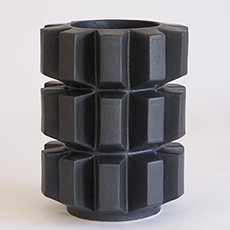
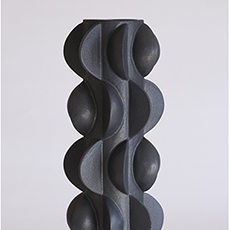
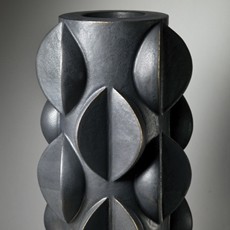
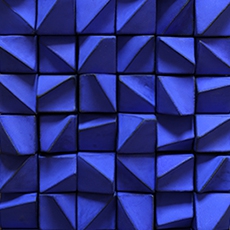
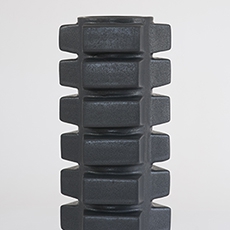
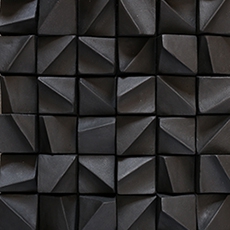
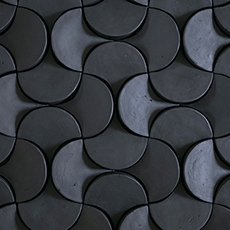
My works are made in stoneware, fired to 1230 C in electric or gas kiln. I use plaster molds to model the different parts in, then assembling them by hand, building in the motion and the rhythm in the surface. The glaze is semi matt, like skin, to promote all the different shades made by light and shadow.
I work fairly slowly, in a sculpting way, allowing my thoughts, memories and feelings to transfer into the material.
“Marie Beckman’s stoneware borrows elements from a machine aesthetic: tube, chimneys, cogs and blocks that interlock as though parts of some mysterious machine. “I do not consciously think about machinery but, rather, in rhythms of depths, shadows and light.” She builds her architectonic objects by hand, casting the finer parts in plaster moulds. Her favourite, graphite-black glaze, in-between matt and gloss, attaches to the surfaces like a layer of asphalt. The glaze is allowed to run over the edges of the piece so that there are gaps revealing other colours beneath as though the item was worn by years of intense use. The black glaze gives a sensation of great warmth. It is strong as cast iron and reassuring to the touch. “I like things to be serious”, Marie Beckman observes and there is a ceremonial atmosphere to her work which has proved attractive church authorities as being suitable for liturgical usage. She often adds gold-leaf which lends the vessels a sophisticated, almost magical effect as they seem to radiate an inner light. She has hand-built a collection of timeless, large-scale pieces with double walls that are suited to public buildings or an elegant dream home. “Somebody maintained that these pieces reminded them of leather sofas”, Marie Beckman confesses. Her most recent work has abandoned organic forms and is geometrically constructed on cylindrical shapes with a touch of steampunk and Jules Verne’s mechanical fantasies.”- Petter Eklund 2012
Works
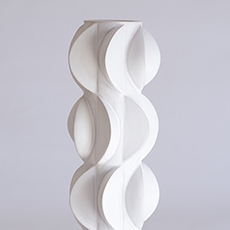
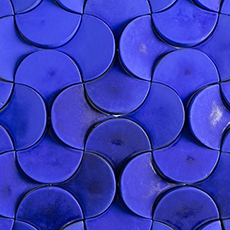
I have worked with ceramics since the mid-1980s, mainly in stoneware. My work develops through a close, practical engagement with clay, form, surface, and firing. The pieces are built gradually, with attention to proportion, structure, and the balance between control and the material’s own movement.
Public Works
My public works have developed over many years through commissions, site-specific contexts, and dialogue with architecture and place.
Each work is shaped by its surroundings — by scale, material, movement, and the people who encounter it. I am interested in how a piece can become part of a public environment without losing its own presence.
.jpg)
.jpg)
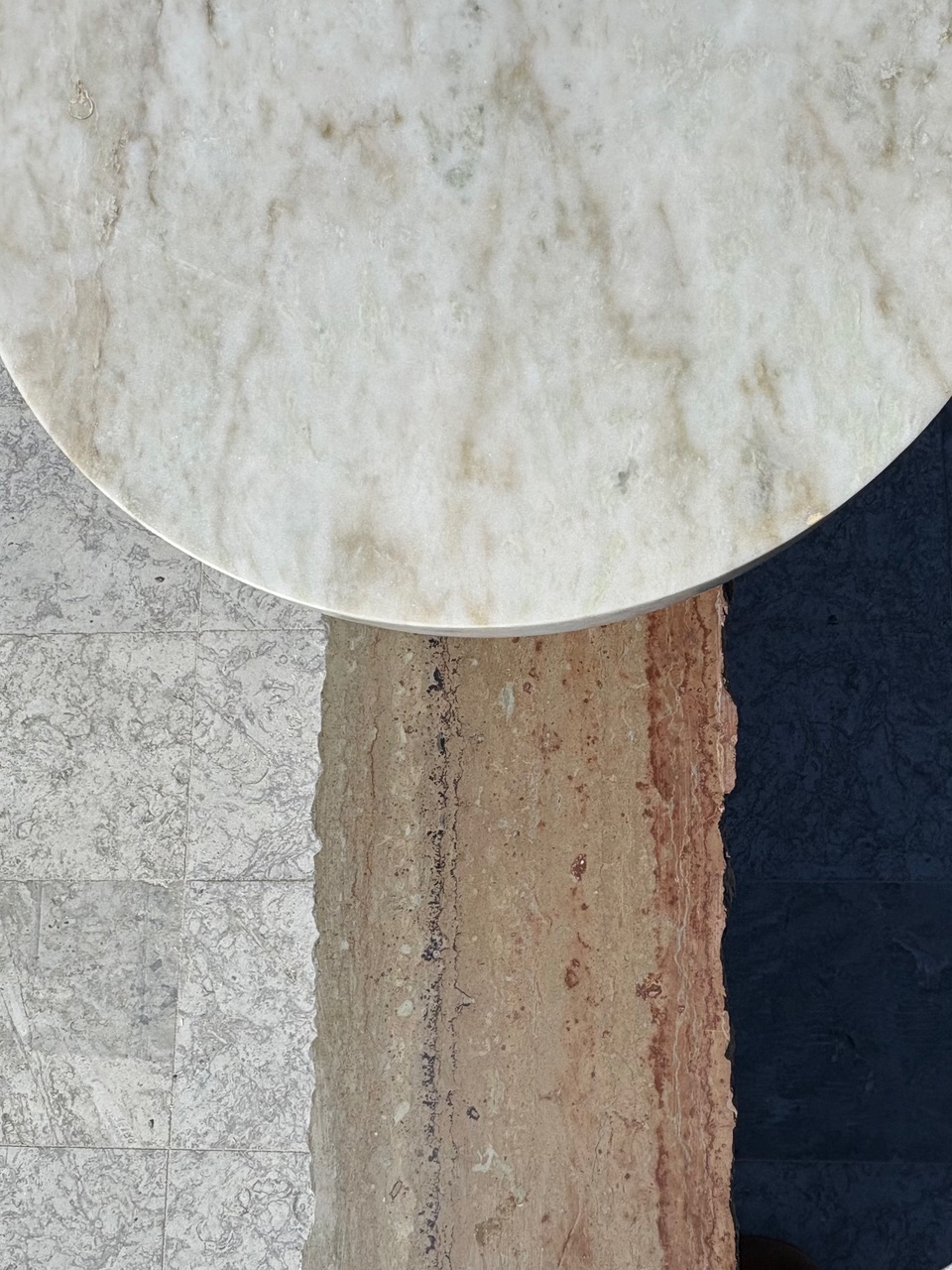
Mångata 2025
Strandsvägens äldreboende.
Motala
Mångata, a sculpture in Kinnekulle limestone and Ekeberg marble, 2025.
A meeting of materials, where the raw stands in contrast to the smooth. Its low centre of gravity invites the viewer to sit, to be warmed by the sun’s heat absorbed by the stone throughout the day.
.jpg)
.jpg)
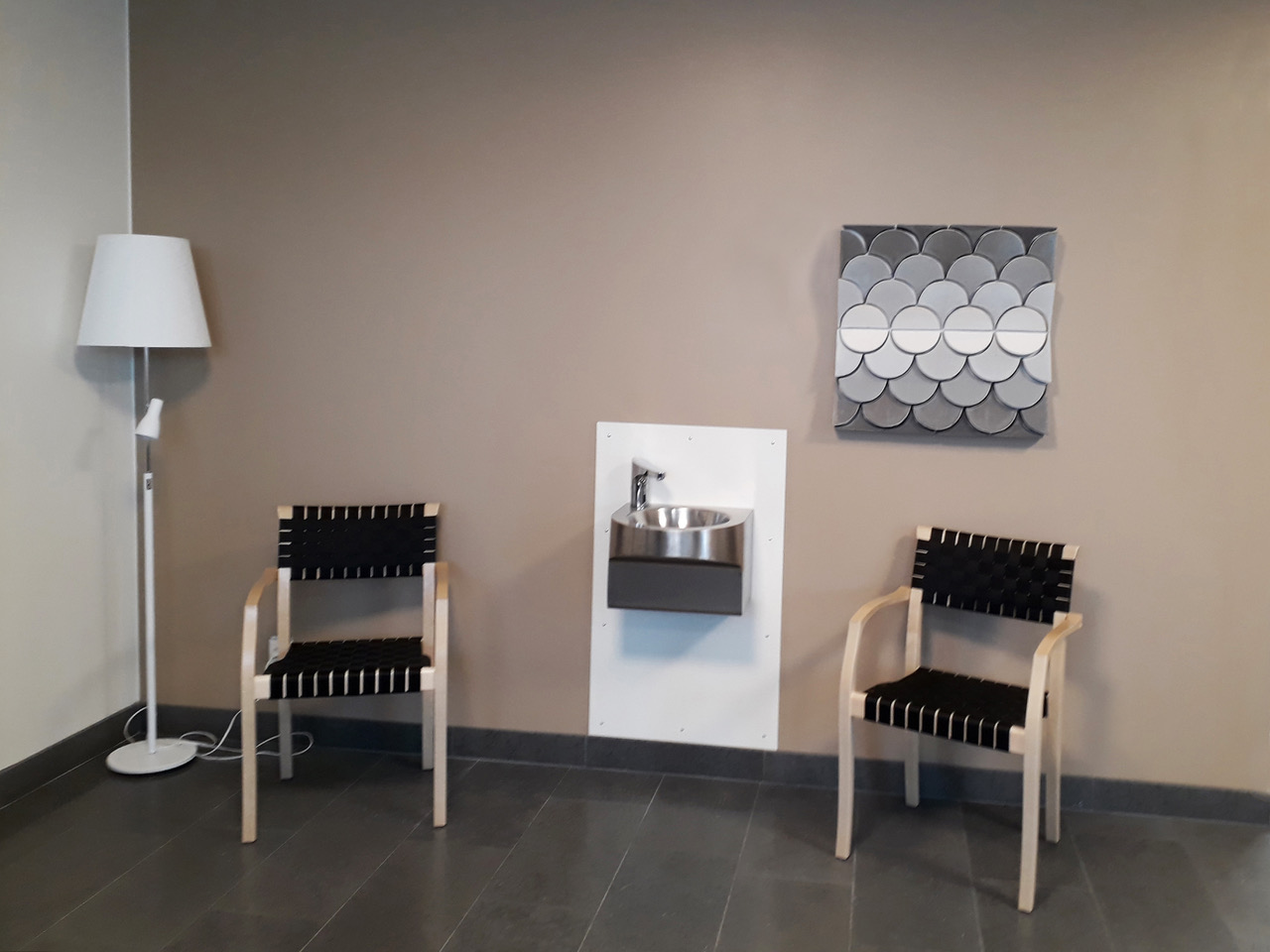
Silentium
2020
Avskedsrum vid Höglandssjukhuset,
Eksjö.
Region Jönköping
A four meter relief in white-glazed stoneware. Positioned as a backdrop behind the catafalque, it was conceived as a surface that could bring a sense of calm to a difficult situation. A repetitive pattern, yet one in constant subtle change, like the surface of water.
.jpg)
.jpg)
.jpg)
Luftrum 2014
Mariahemmet demensboende,
Enskededalen.
Stockholm konst
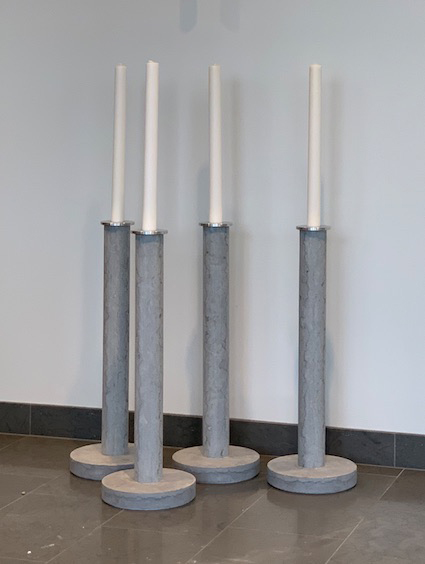
A low table in black concrete supports the floating forms, which may evoke shells or boats pulled up onto a shore. Rising from the centre of a planted bed, the black trunks are clearly visible from the assembly hall. They interact with light and movement, symbolising trees and vegetation.
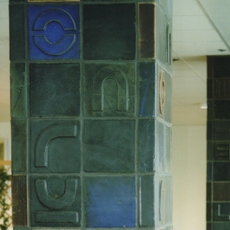
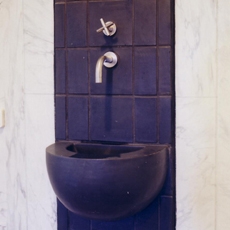
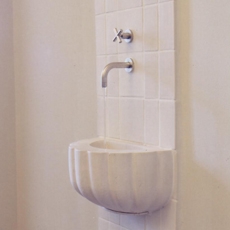
Archive - early public works.
CV
Education
1983 – 84 SHKD Bergen, Norway
1982 – 83 Apprentice in workshops, Sweden and Denmark
1979 – 81 Preparatory School, Leksand Sweden
Selected solo exhibitions2016
Galleri Anna H, Göteborg Sweden2016
blås & knåda gallery, Stockholm Sweden2012
Lidköping Art Gallery, Sweden2012
Halland Art Gallery, Halmstad Sweden2010
blås&knåda gallery, Stockholm Sweden2010
Gallery Formargruppen, Malmö Sweden2008
ArtForum Norrköping, Sweden2007
Gallery Lerverk Gothenburg, Sweden2006
Härnösands Art Gallery, Sweden2005
Galleri5 Visby, Sweden2004
Skånekraft Lund, Sweden2003
blås&knåda gallery, Stockholm, Sweden2002
Gallery Stockselius Skövde, Sweden2000
Art Museum Skövde, Sweden1999
Konstfrämjandet Örebro, Sweden1998
blås&knåda gallery, Stockholm, Sweden1993
Gallery Fabian Västerås, Sweden1992
blås&knåda Stockholm Sweden
Selected group exhibitions2016
Kiruna Konstgille, Sweden2014
Konstforum, Norrköping, Sweden2013
Flow Gallery, London UK2013
Keramiskt Center, Höganäs Sweden2011
“Conversation Pieces” The Röhsska Museum, Gothenburg 2010
COLLECT, Saachi Gallery London UK2009
Hishult Art Gallery, Sweden2007
National museum Ljubljana Slovenia2006
COLLECT, V&A London UK2004
National Gallery of Arts, TiranaAlbania2004
Flow Gallery,LondonUK2002
”Artigianato d`arte Svedese” Rom Italy2001
”Grannar” Sveaborg Helsingfors Finland1998
Gallery Inger Molin Stockholm, Sweden1998
“Expolera98”Västerås Artmuseum, Sweden1998
”Trädgården och konsthantverket” Rosendal Stockholm1996
Swedish ContemporaryCraft,Japan1994
Konstens hus Luleå, Sweden1993
Skövde Art Gallery, Sweden
Commissions2018/2020
"Silentium" Höglandsjukhuset Eksjö, region Jönköping2015
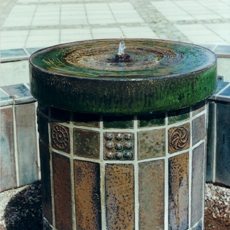
"Brunnen" Trädgårdsstadens gruppboende, Skövde Sweden2014
"Luftrum" Mariahemmet, Enskededalen, Stockholm Sweden2002/2010
"Två pelare" Arena Skövde, Sweden2001
"Vattenpost" Svea Court of Appeal Stockholm, Sweden1994
"Labyrint" County Museum Skara, Sweden
CollectionsNationalmuseet,
Stockholm SwedenStatens Konstråd (The National Public Art Council)
Västerås Art Museum, Sweden
Skövde Art Museum, Sweden
Rackstad Museum Arvika, Sweden
Grants and honours
Art Grants Commitee 2017/18, 2011, 2003/04, 1995/96, 1993, 1989IASPIS 2005, 2004
Project Grant Art Grant Commitee ”Stools” 1998
Regional Grant Skaraborg 2006
Skara Culture Grant 1988
Contact
You are welcome to visit us and see our studio and our showroom.
We are located about 5 km east of Skara.
Call for further directions or go to directions for a map.
Marie Beckman
Brunsbo Lilla Katthagen
532 94 Skara, Sweden
+46(0)705 76 44 77
marie@keramik.se
MARIE
BECKMAN
JUSSI
OJALA